Cordless Pole Saw vs Battery Tree Trimmer: Pick Right Tool
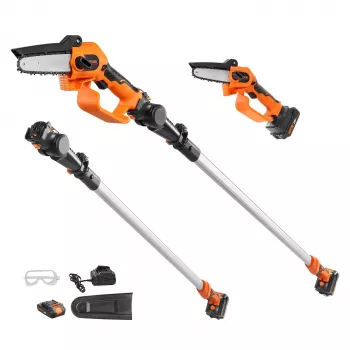
Cordless Pole Saw Chainsaw vs Battery Powered Tree Trimmer: Which Tool Fits the Job?
Battery-powered cutting tools make it easier to keep trees and shrubs tidy without fuel mixing, pull-starts, or extension cords. The tricky part is picking the right style: a cordless pole saw chainsaw for reach-first pruning or a battery powered tree trimmer for faster shaping and light cleanup. The best match comes down to branch thickness, working height, control, and the finish you want in the yard.
What Each Tool Is Designed to Do
A cordless pole saw chainsaw is essentially a small chainsaw head mounted on an extendable pole, built for pruning higher branches while you stay on the ground. A “battery powered tree trimmer” is a broader label that often refers to handheld trimmers used for shaping and light cutting (and sometimes compact saws that are marketed for trimming tasks).
If the work is overhead and involves real branches, the pole format prioritizes reach and safer positioning. If the work is at shoulder height or below and focused on shaping, cleanup, and lighter cuts, a trimmer-style tool usually feels quicker and more maneuverable.
Cutting Power and Branch Size: Practical Differences
Pole saw chainsaws generally handle thicker, woody branches better because the chain-and-bar setup is made for branch removal cuts. Trimmer-style tools are typically optimized for lighter cutting and repeated shaping motions, and they can struggle, stall, or bind on thicker limbs depending on the cutting mechanism and blade/chain design.
A dependable rule of thumb for most homeowners: if the branch is stiff, woody, and needs a clean removal cut at the collar, a pole saw chainsaw is usually the better fit. For twigs, leafy growth, and frequent touch-ups where speed matters more than maximum bite, a trimmer-style tool often feels more efficient.
Reach, Control, and Fatigue
Reach is the pole saw’s biggest advantage: fewer ladder moves and more pruning from stable ground. That said, pole tools can feel front-heavy. The more you extend the pole, the more leverage you’re holding—so fatigue builds quickly during long overhead sessions.
Trimmer-style tools tend to be lighter and easier to aim for detail work, but they may push you back toward ladder use for higher limbs. A smart middle ground is choosing a pole length that covers your typical branch height without maxing out extension every time. Too much extension can reduce accuracy and increase kickback risk if the chain tip contacts a branch unexpectedly.
Speed of Work: One Big Cut vs Lots of Small Cuts
For removing a handful of thicker branches, time savings often come from workflow: fewer tool changes and less repositioning. In that situation, a pole saw can be faster even if each individual cut is a bit more deliberate.
For constant shaping—cleaning up small growth, defining hedge lines, or doing regular seasonal maintenance—trimmer-style tools often move faster minute-to-minute and feel less tiring for frequent, repetitive motions.
If your tasks shift mid-job (high limbs first, then closer-in trimming), a 2-in-1 format can keep momentum without a trip back to the shed. Also, runtime planning matters: when the work is frequent and repetitive, a spare battery or a predictable charging routine can make a bigger difference than chasing the highest power rating.
Safety and Handling Considerations
Battery tools still need chainsaw-level respect: watch the bar tip, keep chain tension correct, and keep the chain sharp to reduce grabbing. For ladder guidance, OSHA’s portable ladder recommendations are a useful reference point: OSHA Ladder Safety (portable ladders). For general cutting-tool precautions, see: CDC/NIOSH Chainsaw Safety. And for battery care and storage basics, UL’s overview is helpful: UL Guidance on Lithium-Ion Battery Safety.
Side-by-Side Comparison
| Category | Cordless Pole Saw Chainsaw | Battery Powered Tree Trimmer |
|---|---|---|
| Best for | Pruning higher branches; limb removal | Shaping, light trimming, quick touch-ups |
| Typical cutting strength | Higher for woody branches | Varies; usually best for lighter growth |
| Reach | High (pole extension) | Low to medium (often handheld) |
| Control for detail work | Moderate; can feel front-heavy | High; easier to aim and reposition |
| Fatigue factors | Overhead leverage and weight distribution | Repetitive hand/arm motion over time |
| Common trade-off | More capability, less nimble | More nimble, less capable on thick limbs |
When a 2-in-1 Pole Saw + Mini Chainsaw Makes Sense
Recommended Option for Mixed Pruning and Trimming
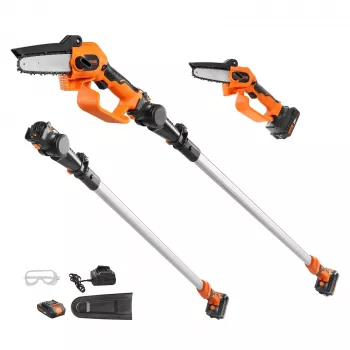
For homeowners who bounce between higher branches and closer trimming tasks, a convertible tool can simplify the workflow and reduce setup time. A solid pick for mixed-yard maintenance is the 2-in-1 Cordless Pole Saw & Mini Chainsaw – 20V Battery Powered Tree Trimmer.
If you’re also browsing other gear around the house and garage, these in-stock items are available as well: Weatherproof Heated Motorcycle Jacket and Deluxe Cat Climbing Tree & Claw Sharpener.
FAQ
Can a battery powered tree trimmer cut tree branches?
Yes—many can cut light branches and green growth, especially during routine touch-ups. For thicker, woody limbs, a pole saw chainsaw or chainsaw-style cutter is typically a better match, so the tool doesn’t stall and the cut stays controlled.
Is a cordless pole saw safer than using a ladder with a saw?
Often it can be safer because it reduces ladder time and lets you work from stable ground. However, overhead cutting still adds falling-debris risk, so protective gear, stable footing, and avoiding directly overhead cuts remain important.
What maintenance matters most on a cordless pole saw chainsaw?
Prioritize a sharp chain, correct chain tension, and proper bar/chain lubrication if the tool uses oiling. Keeping the sprocket area clean and storing batteries correctly also helps protect runtime and long-term performance.














Leave a comment